
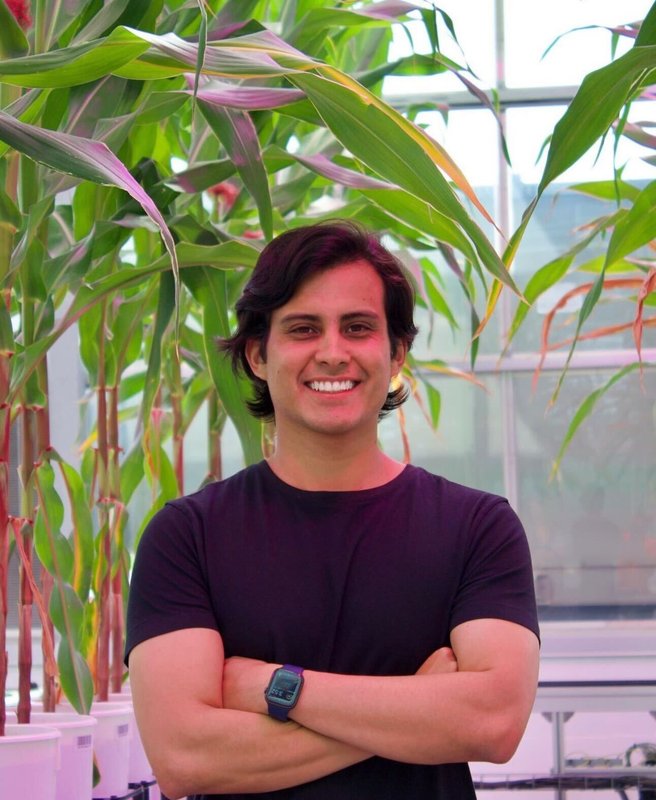
Vladimir Torres-Rodriguez
Research Assistant Professor
Dr. Vladimir Torres was a Research Assistant Professor at the University of Nebraska–Lincoln. His work integrated large-scale RNA-Seq and phenotypic datasets from over 850 sorghum lines, 700 maize lines, and 500 soybean lines adapted to different environmental regions, aiming to identify genes that regulate key traits like flowering time and plant height. He developed and applied bioinformatics pipelines in R and Python, combining tools and comparative genomics approaches to enhance gene discovery across species using orthologs. His methodology uncovered biologically meaningful candidate genes that single-species analyses often miss. While in the Schnable Lab, Dr. Torres co-supervised a team focused on gene validation through tissue culture, transformation, and gene editing in maize and sorghum. He is now a Scientist at Traits Company.
In the News
-
PAG Lab Reunion
Hit a new record for the number of lab alumni attended: L→R Sunil K. Kenchanmane Raju (now of UC Riverside), James Schnable, Zhikai Liang (now of NDSU), Ravi Mural (now of SDSU), and Vladimir Torres-Rodriguez (now a Scientist at Traits Company). -
TPJ Outstanding Paper Award
Vladimir Torres-Rodríguez’s 2024 paper Population-level gene expression can repeatedly link genes to functions in maize has been selected as The Plant Journal’s Outstanding Original Article award of 2024. -
Nature Genetics publication
Drs. Vladimir Torres-Rodriguez and Guangchao Sun contributed to a Nature Genetics paper. -
Sofiya Arora joins the lab
We welcomed Sofiya Arora to our lab. Sofiya is transferring to our lab from Entomology and will be working with Prof. Torres-Rodriguez to measure the phenotypic impact of cis-regulatory variation in maize. -
Lab presentations at Nebraska Plant Science Symposium
Five members of our lab—Amany (talk), Harshita (talk), Waqar, Ramesh, Nikee, Jensina, and Vladimir—explained their work at the 2024 Nebraska Plant Science Symposium. -
Maize Genome Conference presentations
The Schnable Lab presented at the Maize Genome Conference hosted in Raleigh, NC. Two of our grad students presented lightning talks about their posters: Nikee Shrestha and Michael Tross. In addition, Harshita Mangal, Hongyu Jin, Vladimir Torres, Jensina Davis, Waqar Ali, and Ramesh Kanna presented posters.
Recent Publications
- (2026) A sorghum-anchored pan-grass syntenic gene set in grasses. NAR Genomics and Bioinformatics Accepted
- (2025) Phenotypic variation in maize can be largely explained by genetic variation at transcription factor binding sites. Nature Genetics doi: 10.1038/s41588-025-02246-7 bioRxiv doi: 10.1101/2023.08.08.551183
- (2025) Evolving best practices for transcriptome-wide association studies accelerate discovery of gene-phenotype links. Current Opinion in Plant Biology doi: 10.1016/j.pbi.2024.102670
- (2025) Transcripts and genomic intervals associated with variation in metabolite abundance in maize leaves under field conditions. BMC Genomics doi: 10.1186/s12864-025-11580-3 bioRxiv doi: 10.1101/2024.08.26.609532
- (2025) Genes and pathways determining flowering time variation in temperate adapted sorghum. The Plant Journal doi: 10.1111/tpj.70250 bioRxiv doi: 10.1101/2024.12.12.628249
- (2025) Quantitative genetics of photosynthetic trait variation in maize. Journal of Experimental Botany doi: 10.1093/jxb/eraf198 bioRxiv doi: 10.1101/2024.11.25.625283
- (2025) Off-the-shelf image analysis models outperform human visual assessment in identifying genes controlling seed color variation in sorghum. The Plant Phenome Journal doi: 10.1002/ppj2.70013 bioRxiv doi: 10.1101/2024.07.22.604683
- (2024) Data driven discovery and quantification of hyperspectral leaf reflectance phenotypes across a maize diversity panel. The Plant Phenome Journal doi: 10.1002/ppj2.20106 bioRxiv doi: 10.1101/2023.12.15.571950
- (2024) Population level gene expression can repeatedly link genes to functions in maize. The Plant Journal doi: 10.1101/2023.10.31.565032 bioRxiv doi: 10.1101/2023.10.31.565032
- (2022) Genome of Paspalum vaginatum and the role of trehalose mediated autophagy in increasing maize biomass. Nature Communications doi: 10.1038/s41467-022-35507-8 (Foltz A is 17 of 26 authors) bioRxiv doi: 10.1101/2021.08.18.456832